
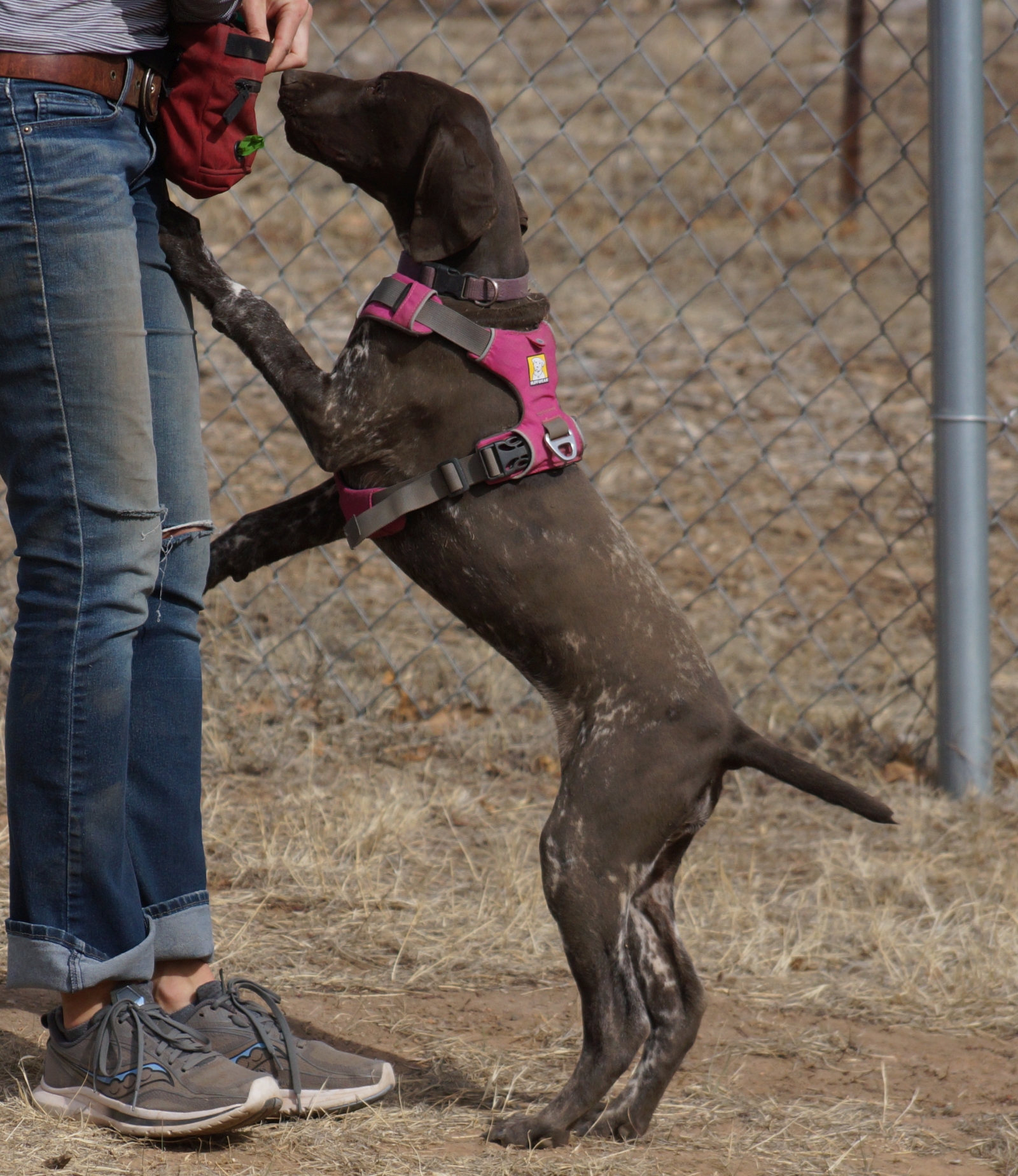
DOG TRAINING OFFERED IN-PERSON AND ONLINEOur dog training services are delivered in almost any format that meets your needs. We have GROUP CLASSES at our indoor and outdoor facilities on our farm, ONLINE LIVE STREAMING classes, and SELF-PACED VIDEO-BASED training through our Online Dog Training Course. Our PRIVATE TRAININGS can be done in-home, outside, in public dog-friendly locations, at our facility on our farm, online via phone or video conferencing and through email. |
How do I stop. . . jumping, barking, lunging? A common question for me is how to stop unwanted behaviors. Whether the dog is jumping, barking, lunging, whining, peeing, biting, getting on furniture, surfing counters, snatching food, chasing the cat, or doing any other number of unwanted behaviors, the question is always the same. How do I stop it?
In most cases, people are trying to stop the behavior once it has already started. They try to stop the dog from jumping on people when he's already jumping. They try to stop the dog from surfing countertops when the dog's paws are already on the countertop. They are trying to get the dog off the couch when the dog is already on the couch.
In all of these situations, the people are reacting to something that is already happening or has already happened. And sometimes we do have to deal with something that is already going on.
However, if you really want to stop unwanted behaviors that occur often, waiting for them to happen is NOT the most effective strategy for stopping the behaviors from happening again in the future.
PREVENTION is the key. Any time I can PREVENT the behavior from starting in the first place, I am going to reduce or eliminate the behavior from happening in the future a lot faster.
Let's take jumping on people as our example. Every time your dog greets people by jumping on them, they are building a habit of jumping on people to greet. Every time they practice, they get better and better at it. And by that, I mean they get better at doing it without thinking about it. It is becoming a HABIT. Once it becomes a habit, it gets harder and takes longer to eliminate the habit.
Even if I can ensure it NEVER gets rewarded with attention from the people, the jumping is going to take longer to eliminate if I am allowing it to happen in the first place.
However, if I can prevent it from starting, I can create NEW HABITS a lot faster and easier. Perhaps I want my dog to greet by sitting and letting people approach the dog. Perhaps I want the dog to approach the people with all four feet on the floor. Perhaps I want the dog to bring a toy to the person. Again, with all four feet on the floor. I can establish whatever new behavior I want, as long as it's realistic for the dog to do, and it's as close to incompatible with jumping as I can find.
Any time I allow the behavior to happen, and THEN direct the dog to do something else, I am still allowing the unwanted behavior to be practiced and become a regular part of the dog's behavior. They are still building the pattern of jumping first and THEN doing something else.
I need to help the dog learn a new pattern of behavior that does NOT include jumping. Or any other unwanted behavior.
Don't focus on interrupting or redirecting the unwanted behavior. Focus on PREVENTING the unwanted behavior.
Now, prevention is much easier if the behavior is PREDICTABLE. If it tends to always happen in the same circumstances or at the same times. The more easily I can predict when it's going to happen, the easier it is to prevent.
Going back to our jumping on people example, if it always happens when visitors come over, or when family members arrive home, or at other predictable times, then it's much easier to put a plan in place to prevent it from happening. That gives us a chance to help instill new behaviors in it's place.
Preventing it is just the first step. The second step is ensuring we are teaching an ALTERNATIVE BEHAVIOR in place of the unwanted behavior. If I prevent it but don't replace it, then I am still going to have trouble.
Prevention first. Alternative behavior second.
How do you prevent it? Do some planning in advance. Don't wait for it to happen and then think about what you're going to do. If the unwanted behavior is happening when visitors come over, or family members arrive home, think about your plan before the situation occurs.
Prevention might include things like having the dog on leash, having baby gates set up, or having the dog outside temporarily.
Alternative behaviors prevent your dog from creating a new unwanted behavior in place of the current unwanted behavior. Alternative behaviors might include teaching your dog a solid Sit, a reliable Place, or a dependable Touch, or a Find It Game with a treat scatter on the floor.
We can eliminate and replace unwanted behaviors much faster by using prevention first and then an alternative behavior to take place of the unwanted behavior.
Our goal is to positively impact the lives of as many dogs and their families as we can, in part through our extensive library of video, infographics and text articles. |






Leave A Comment